
Supreme Court Justice Prasanna Varale has voiced serious concerns over the closure of Marathi-medium schools, inadequate facilities in Ashram schools, and insufficient growth in Maharashtra's education budget, suggesting that greater spending could have prevented these shutdowns.

The Supreme Court has granted bail to Sandip Ghosh, former principal of RG Kar Medical College Hospital, who was accused of financial irregularities and manipulating merit scores. The decision was based on his two-year incarceration and the slow progress of the trial, with only 7 out of 147 witnesses examined so far.

The Supreme Court has dismissed a plea by the Mamata Banerjee-led TMC faction to operate four debit-frozen bank accounts, upholding a Calcutta High Court order. The accounts, holding around Rs 804 crore, are under investigation due to alleged cash deposits and a factional dispute within the party. The court noted the Election Commission's symbol freeze and requested the High Court to expedite the larger adjudication.

The Supreme Court has issued notices regarding Tarun Tejpal's sentencing in a 2013 rape case, responding to both his petition against a 10-year prison term and the Goa government's plea for an enhanced sentence.

The Supreme Court has suspended the sentence of Hopeson Nignshen, a self-styled NSCN(M) "lieutenant", who was convicted for the abduction and killing of three Manipur government officials in 2009. Nignshen has been incarcerated for over 17 years, and his appeal is still pending. The suspension comes with the condition that he remains within Delhi until his appeal is disposed of.

The Supreme Court has dismissed a Public Interest Litigation (PIL) seeking mandatory and uniform labelling of ethanol percentage in petrol at fuel pumps. The petitioner, Narendra Kumar Goswami, was advised to approach the jurisdictional high court for relief, with the Attorney General arguing it was a proxy litigation.

The Supreme Court is set to hear a petition seeking mandatory and uniform labelling of ethanol percentage at petrol pumps and a public database on vehicle compatibility with ethanol-blended fuel. The plea also calls for an expert committee to assess the impact of E20 fuel on vehicles, environment, and food security, and a consumer disclosure protocol.

The Supreme Court, while hearing a bail plea in a murder case, made significant observations about the changing nature of society, the vulnerability of the modern generation, the impact of nuclear families, and the role of technology in child-rearing.
The Supreme Court has set aside the bail granted to Sonam Raghuvanshi, accused of murdering her husband Raja Raghuvanshi during their honeymoon in Meghalaya. The court ordered her to surrender within three weeks, allowing for a fresh bail application if the trial does not conclude within six months.

The Supreme Court was informed that AIIMS experts have concluded self-styled godman Asaram does not require hospitalisation but needs round-the-clock medical assistance, as he seeks interim bail on health grounds.
The Supreme Court has denied interim bail to self-styled godman Asaram, who is serving a life sentence for sexually assaulting a minor. While rejecting his plea for bail on health grounds for now, the court permitted him to engage a trained caretaker for round-the-clock assistance. The court noted that Asaram's counsel had previously moved for parole, and his health condition will be monitored.

The Rajasthan high court has granted 20-day parole to self-styled "godman" Asaram, who is serving a life sentence in a 2013 case of sexually assaulting a minor, saying the state government failed to justify its decision to reject his parole application.

The Supreme Court has asked the Rajasthan government for an update on the health of self-styled godman Asaram, who is seeking interim bail on medical grounds. The court expressed concern about his well-being, stating "We don't want any untoward thing to happen." Asaram's counsel claims he is a high-risk patient, while the Solicitor General noted he was recently seen walking in Ayodhya and Kashi Vishwanath. The apex court is hearing his plea challenging the Rajasthan High Court's decision to uphold his conviction and life sentence for the rape of a minor.
The Supreme Court will hear a plea from the Meghalaya government challenging the bail granted to Sonam Raghuvanshi, accused of murdering her husband during their honeymoon. The case hinges on a legal question regarding a typographical error in the arrest memo and whether it justifies bail in a murder case.
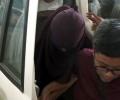
The Supreme Court has questioned the conduct of Sonam Raghuvanshi, accused of killing her husband during their honeymoon in Meghalaya, suggesting she surrender and face trial. The court is also examining whether a typographical error in the arrest memo justifies her bail.
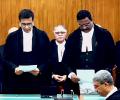
Karnataka high court Chief Justice P B Varale was on Thursday administered the oath of office as a Supreme Court judge by Chief Justice of India Justice D Y Chandrachud in New Delhi.

The Supreme Court observed that Hinduism is a way of life, stating that mandatory temple visits or rituals are not necessary to be considered a Hindu; even lighting a lamp at home suffices.

A nine-judge Supreme Court bench has reserved its order on petitions related to discrimination against women at religious places, including the Sabarimala temple, and the scope of religious freedom.
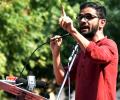
The Supreme Court granted interim bail to two Delhi riots accused, while addressing concerns about conflicting views on bail under the Unlawful Activities Prevention Act (UAPA). The court referred the question of law on whether prolonged incarceration can override UAPA restrictions to a larger bench.
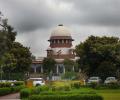
The Supreme Court of India has observed that the practice of excommunicating Parsi women for entering into interfaith marriages is prima facie discriminatory, emphasising that the right of conscience is a birthright.

The Supreme Court of India has stated that religious institutions must have structure and norms for their functioning, emphasising that the right to manage a religious institution does not imply an absence of order.
The Supreme Court of India has dismissed the use of information from 'WhatsApp University' as evidence in a case concerning religious freedom and discrimination against women at religious sites, including the Sabarimala Temple.

The Supreme Court of India has voiced concerns about the potential consequences of individuals questioning religious practices in constitutional courts, warning it could lead to the fragmentation of religions and civilisation. A nine-judge Constitution bench is hearing petitions related to discrimination against women at religious places and the scope of religious freedom.
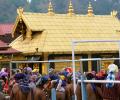
The Shabari story in the Ramayana found mention before a nine-judge constitution bench of the Supreme Court on Wednesday while hearing petitions related to discrimination against women at religious places, including the Sabarimala temple in Kerala.
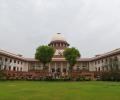
The Supreme Court of India is hearing petitions related to discrimination against women at religious places, including the Sabarimala temple in Kerala, and the scope of religious freedom practised by multiple faiths.

The Centre has supported the restriction on women of menstruating age entering Kerala's Sabarimala temple, arguing that the Supreme Court's 2018 judgement assumes male superiority.

The Supreme Court is reviewing the detention of climate activist Sonam Wangchuk under the National Security Act, considering his health condition and allegations of inciting unrest in Ladakh.
The Supreme Court is hearing petitions related to discrimination against women at religious places, including the Sabarimala temple. A nine-judge bench is examining the scope of religious freedom and the exclusion of women based on age and menstrual status.
The Travancore Devaswom Board (TDB), managing the Sabarimala temple, argued in the Supreme Court that religious beliefs should be judged subjectively by the community, as the court hears petitions related to discrimination against women at religious places.
The Supreme Court has stated that roads cannot be blocked for religious activities and that while religious denominations have autonomy in worship, the government can interfere if secular activities are affected.

The Supreme Court of India granted bail to a Punjab resident accused of attempt to murder, emphasising that incarceration without trial is a form of punishment. The court noted the accused had been in jail for two years without the trial commencing.

The Supreme Court questioned the chief priest of the Sabarimala Ayyappa Temple regarding the constitutionality of preventing believers from touching the deity, during hearings on discrimination against women at religious sites.
The Supreme Court has directed the central government to provide accurate transcripts of videos related to climate activist Sonam Wangchuk's detention, emphasizing the need for precision in translations, especially with the advent of Artificial Intelligence.
The Supreme Court of India has asserted its jurisdiction to determine what constitutes a superstitious practice within a religion, during a hearing on petitions related to discrimination against women at religious sites.
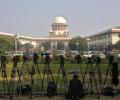
A nine-judge Supreme Court bench has commenced hearing on petitions related to discrimination against women at religious places, including the Sabarimala temple, and the scope of religious freedom across faiths.
The Supreme Court of India questioned the Centre regarding the eligibility of non-devotees to challenge the customs of the Sabarimala temple in Kerala, during a hearing on religious freedom and discrimination against women at religious sites.

The Centre has informed the Supreme Court that the restriction on women of menstruating age entering Kerala's Sabarimala temple is a matter of religious faith and denominational autonomy, falling outside the purview of judicial review. Solicitor General Tushar Mehta argued that courts should not apply 'secular standards of reason' to religious practices.
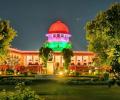
The Centre has asked the Supreme Court to reconsider its judgements decriminalising adultery and same-sex relationships, arguing they were based on a subjective application of 'constitutional morality'.

The Supreme Court of India has emphasised the importance of open access to all temples and 'maths' for everyone, warning that excluding any denomination would negatively impact Hinduism and divide society. This statement was made during hearings on petitions related to discrimination against women at religious sites and the scope of religious freedom.
The Supreme Court has upheld a Madras High Court decision prohibiting animal sacrifice and granting limited prayer rights to Muslim devotees on the Thiruparankundram hills in Tamil Nadu.
